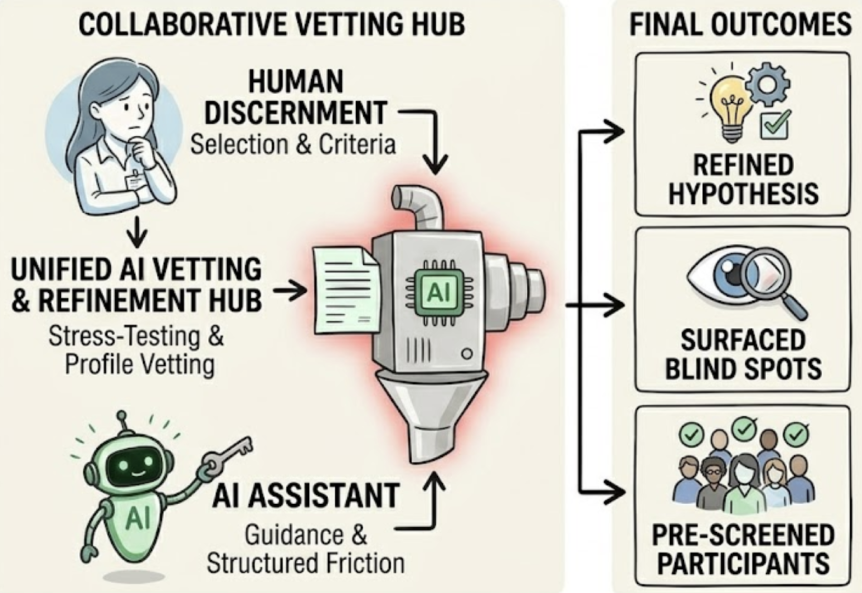
As a leading UX research and design firm, gotomedia initiated an internal study within our network and community to explore how UX researchers can meaningfully leverage AI in our process. For this particular study we wanted to conduct rapid research without losing quality. We approached this work intentionally, determined not to let our expertise disappear into an AI abyss, and cautious not to let unrefined ideas come across as deeper insight than they truly are.
Throughout the study, we leveraged AI LLMs as a research design and synthesis assistant to support the rapid development, refinement, and validation of an exploratory qualitative study.
It felt appropriate to incorporate AI into this process. After all, the study topic was focused on advanced AI users, specifically their trust in, reliance on, and privacy considerations regarding AI LLMs.
So, how specifically did we integrate AI into our research design and framework?
We began by defining the study framework and drafting the hypotheses we aimed to explore. That intellectual foundation was ours to build. Internally, researchers and stakeholders aligned on what we wanted to study, why it mattered, and how to conduct the study.
Only after that groundwork was established did we bring AI into the process. We used it as a research support assistant, a thought partner to pressure-test assumptions, expand lines of inquiry, and surface perspectives we might not have considered.
AI did not define the research. It strengthened it.
Key Areas AI Served As a Research Support Assistant
Below, we outline the specific tasks in which we leaned on AI as research assistants.
1. Research Hypothesis Stress-Testing
After brainstorming our hypotheses, we asked AI to review them with our segment and study topic in mind. The goal was to pressure-test our thinking and ensure we weren’t including or omitting details that could introduce bias and unintentionally invalidate the research. AI research assistant tasks:
- Surfaced additional hypothesis ideas we could consider to expand our perspective.
- Helped articulate and refine our initial hypotheses around AI reliance, trust, and privacy behaviors.
2. User Segment & Screening Refinement
Once we were confident in our hypotheses, we moved on to defining our recruiting segments and drafting our screening questionnaire. AI research assistant tasks:
- Recommended additional screener questions to better capture the intensity of use.
- Refined our “advanced” and “lite” AI user segments by ensuring we defined clear criteria, including frequency of use, tool diversity, paid usage, and duration of use.
- Reviewed and strengthened the recruitment screener to ensure it reliably identified the target population.
3. Discussion Guide Development (45-minute 1:1 Interviews)
We already knew our study goals, so the next step was drafting the discussion guide questions. Once the guide was framed, we leveraged AI to review it for bias and determine whether we were missing questions that could help us fully reach our goals. AI research assistant tasks:
- Identified where early discussion goals and questions risked being hypothesis-confirming.
- Helped reframe goals and questions to support exploratory, non-confirmatory research.
- Supported iterative revisions to reduce bias and ensure alignment with research goals.
- Ensured the guide encouraged behavioral storytelling, enabled comparison across channels such as AI versus human versus other tools, and allowed trust and privacy themes to emerge organically.
4. Measurement Design (Lightweight Scoring)
Given that this rapid research framework should scale globally, we wanted a structured way to score advanced LLM users. We worked with AI to craft a weighted score that defined a usefulness-to-disclosure ratio.
This scoring approach was not intended to be scientific. Instead, it was designed to be cross-comparable, allowing us to consistently evaluate similar yet distinct attitudes without letting moderator bias or judgment influence interpretation. This would be especially important if the study expanded into other countries. AI research assistant tasks:
- Assisted in defining weighting logic, interpretation boundaries, and responsible use of the score.
- Designed a structured, non-scientific scoring framework to complement qualitative insights.
- Reviewed our scoring questions and helped reframe them to minimize cultural and social bias while preserving comparative value.
5. Synthetic Participant Modeling
After finalizing the discussion guide, we wanted to test it with synthetic participants before moving into live interviews with real people. AI research assistant tasks:
- Generated multiple synthetic participant profiles that fit our target criteria.
- Simulated full interview responses to pressure-test the discussion guide and ensure it could flex across different user types.
6. Research Rigor & Bias Mitigation
Throughout the process, AI functioned as a rapid research collaborator, enabling faster iteration while maintaining methodological rigor. Although there were areas where AI fell short, e.g., suggesting leading questions for screening surveys and discussion guides, with researchers’ oversight, we were able to catch that and effectively leverage the AI tools for the following:
- Supported the work without replacing human judgment, moderation, or interpretation.
- Improved clarity and reduced bias in research materials.
- Strengthened participant selection criteria.
- Reinforced alignment between research goals, methods, and outputs.
Rapid Research with AI Was Valuable
Overall, it was valuable to have AI as research support. It gave us space to explore and test our study framework and goals more efficiently. It was able to rapidly produce additional survey or discussion guide questions that we could then review and revise.
AI flagged areas where assumptions could unintentionally shape participant responses, offered alternative viewpoints, and prompted us to consider cultural nuances we may have overlooked. However, the process only worked because experienced researchers led it. AI supported the work for faster design and iteration. It did not direct it.
One natural concern in sharing this process is whether relying on AI in any meaningful way risks weakening research rigor or diminishing the value of experienced researchers.
If AI defines the research direction, interprets findings, or replaces human judgment, rigor will suffer, expertise will erode, and the work will feel generic.
That didn’t happen here. AI did not determine what we studied, why it mattered, how participants were selected, how conversations were moderated, or how insights were interpreted. Those decisions required context, discernment, and experience. AI functioned as structured friction. It helped us stress-test assumptions faster, surfaced blind spots, and accelerated iteration. It did not decide what was true, meaningful, or actionable.
Rigor still came from:
- Clear research design
- Intentional hypothesis framing
- Careful participant selection
- Skilled moderation
- Human interpretation and synthesis
If anything, using AI this way raised our standard. It forced us to articulate our thinking more clearly and confront our biases earlier in the process.
Clients do not hire research firms for faster note-taking or quicker draft guides. They hire for judgment, deeper pattern recognition, contextual interpretation, and strategic translation. AI can support those outcomes. It cannot replace them. Used thoughtfully, it becomes a tool that sharpens expertise rather than replaces it.
About the Author